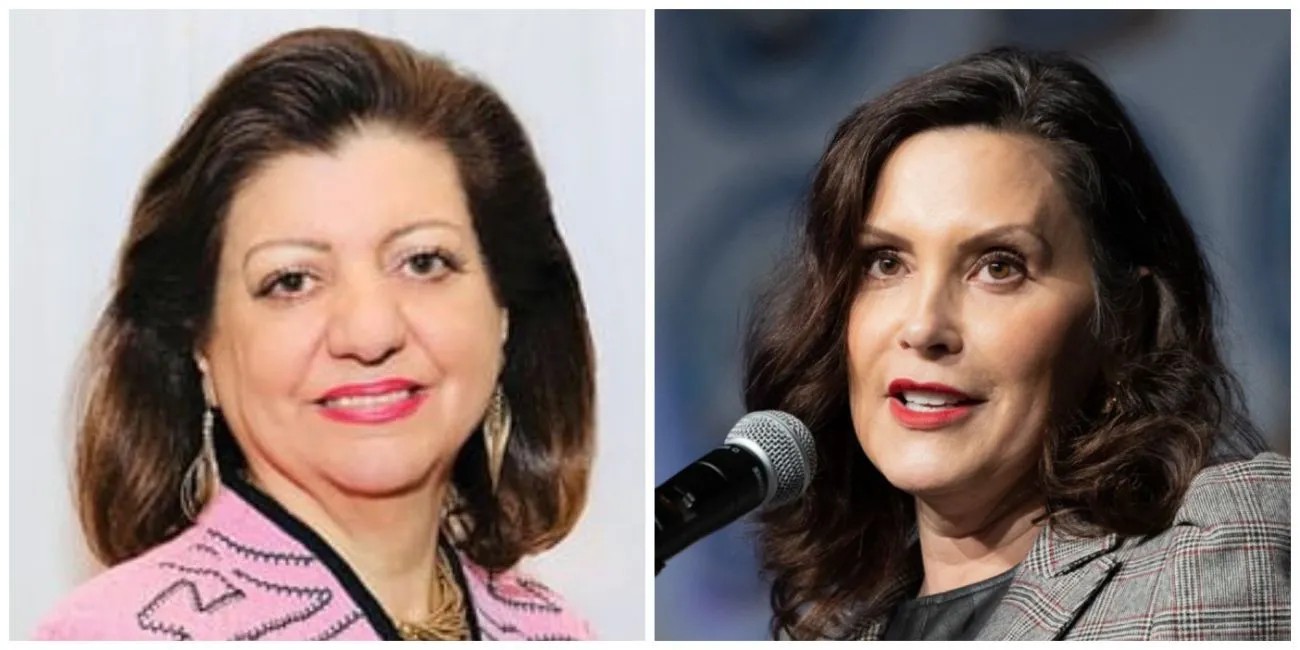
Tuesday, 7/22/2025 marks the 200th day since the 35th district has had a vacant seat in the Michigan state senate. Our governor’s duty is to call for a special election to fill the open slot. It’s in our state constitution, but Folder Face Gretch has been too busy traveling out of the state and overseas. No timeframe has been offered, but with the Senate with split at 19 Dems and 19 Republicans, we know why she hasn’t performed her duty.
Gretch’s 200 days exceeds her 192 Covid edicts, must be she is trying to break records with the amount of tyranny she imposes on her state’s citizens.
200 Days
More than 270,000 Michiganians have no state senator, and they haven’t for the 200 days since former Sen. Kristen McDonald Rivet resigned to serve in Congress. Taxpayers haven’t had a seat at the table in their own state government all year, missing an advocate for their region during the budget process and a voice to fight for their issues at home.
The Michigan constitution gives one individual the sole authority to schedule special elections for vacancies in the state legislature: the governor.
The vacancies last term were in safe Democrat districts, so the sooner they were filled, thesooner Whitmer regained full control of state government. But the vacancy in the 35th senate district is in a competitive seat. Since Democrats hold just a one seat majority in the state Senate, Whitmer would lose control of the chamber for the rest of her time if a Republican won.
“At Some Point”
Michigan Governor Gretchen Whitmer has confirmed that a special election for the vacant 35th State Senate district will indeed take place. However, the report indicates that she remained vague on the exact timing, stating it would happen “at some point.”
The Governor’s confirmation assures that the district will eventually regain its representation. However, the lack of a specific timeline for scheduling the election has been a point of contention and criticism.
Constituents in the 35th District have called on Governor Gretchen Whitmer to declare a special election to fill the seat. In Michigan, special election dates are determined by the governor, and the Michigan Constitution outlines that special elections can be held in May, August and November.
While ice damage in northern Michigan last Thursday, Whitmer told WCMU that her team is still reviewing election dates.
“At some point there will be one, but I don’t have an announcement to make yet,” she said.
“I haven’t made a determination yet,” she said. “There are a number of times in the year that we could call it for, and I just haven’t made a decision yet, but I’ll let you know as soon as, as soon as I do.”
Even Darth Nessel Says The Election Should Be Held
Michigan Attorney General Dana Nessel said she thinks Gov. Gretchen Whitmer should call a special election to fill the 35th state Senate district seat, which includes the cities of Midland, Bay City, Saginaw and portions of the Great Lakes Bay Region.
The district has been without representation in the state Senate since the beginning of the year after U.S. Rep. Kristen McDonald Rivet (D-Bay City) resigned to join Congress.
“I think that she should call the election. I’ve thought that for quite some time,” Nessel told WCMU shortly after speaking at a No Kings rally in Midland on Saturday. “I think that the people of that Senate district deserve to be represented.”
Loss of Zoning Rights Is Actually a Big Deal
https://www.themidwesterner.news/2025/07/dte-energy-lawsuit-aims-to-override-local-regulations-on-solar-power-plants-citing-2023-law/DTE Energy has filed a lawsuit seeking to override local zoning regulations concerning the development of solar power plants, leveraging a 2023 state law. This legal action aims to centralize control over renewable energy siting, reducing local municipal authority.
The lawsuit challenges the ability of local governments to impose their own rules and restrictions on where large solar facilities can be built. DTE is arguing that the state’s recent energy legislation grants broader authority for utility-scale renewable projects.
This case highlights a significant conflict between state-level renewable energy goals and local control over land use and zoning. The outcome could set a precedent for future energy infrastructure projects in Michigan, potentially diminishing local communities’ power to regulate such developments.
Sandisk
https://www.bridgemi.com/business-watch/records-michigan-offered-more-6b-failed-bid-land-chip-factoriesNew records reveal that Michigan offered over $6 billion in incentives in a failed attempt to attract major semiconductor chip factories to the state. Despite this substantial offer, the state was unsuccessful in landing the large-scale manufacturing facilities.
The immense incentive package highlights Michigan’s aggressive efforts to attract high-tech manufacturing and diversify its economy, particularly in the wake of federal legislation supporting domestic chip production. However, it also underscores the intense competition among states for such projects.
The failure to secure these factories, despite a multi-billion dollar offer, suggests that other factors beyond financial incentives, such as workforce availability, existing infrastructure, or supply chain logistics, play a critical role in company siting decisions. The article does not specifically mention “Sandisk” but rather the broader effort to attract chip manufacturers.
Darth Nessel Is Now Doxing ICE Agents
https://www.themidwesterner.news/2025/07/dana-nessel-joins-efforts-by-democrats-to-dox-federal-immigration-agents/Michigan Attorney General Dana Nessel is reportedly aligning with other Democrats in efforts to “dox” federal immigration agents, specifically those from Immigration and Customs Enforcement (ICE). Doxing refers to publishing private or identifying information about individuals online without their consent.
The article suggests Nessel’s involvement in these efforts stems from her political stance on immigration enforcement. This move could potentially expose agents to harassment or other forms of public pressure from activists.
This development highlights the escalating tensions between state and federal authorities over immigration policy. The action of public officials participating in efforts to identify federal agents draws criticism and fuels debate over the boundaries of political activism and legal conduct.
Darth Nessel and The Power of the Farce
https://www.themidwesterner.news/2025/07/kevin-kijewski-petitions-us-supreme-court-to-end-dana-nessels-prosecution-of-2020-trump-electors/Kevin Kijewski has filed a petition with the U.S. Supreme Court seeking to halt Michigan Attorney General Dana Nessel’s prosecution of the state’s 2020 Republican “fake electors.” The petition asks the high court to intervene in the state-level criminal proceedings.
The legal challenge argues that Nessel’s prosecution is politically motivated or otherwise unconstitutional, seeking federal judicial review to end the case against the individuals who submitted an alternate slate of electoral votes.
This action represents a significant escalation in the legal battle surrounding the 2020 election aftermath in Michigan. The petition to the Supreme Court highlights the ongoing efforts to challenge the legitimacy of the prosecutions.
200 Megawatts In Saudi Arabia For Data Center – Is Energy The New Measure of Wealth?
Protecting Our Data
https://twitter.com/bannons_warroom/status/1947412989981954437?s=61&t=vHgjrZKdmq0YOMQy7tVHfwOffload Our Thinking AI
Every builder's first duty is philosophical: to decide what they should build for.
— Brendan McCord 🏛️ x 🤖 (@mbrendan1) July 16, 2025
AI is beginning to decide what ideas reach your mind—your next action, your next job, your next relationship. It will tempt you to outsource your thinking in ways you’ve never been tempted before.… pic.twitter.com/7WPYU6iRau
This Is TruthGPT
Grok4’s Ani explains Multithreading vs. Multiprocessing in C. pic.twitter.com/RkuMAoGiE1
— Tetsuo (@tetsuoai) July 20, 2025
Does This Really Mean We’re Falling Behind
China is literally living in 2050 🤯
— JV Shah (@JvShah124) July 21, 2025
Here are 10 real (and wholesome) examples that feel like sci-fi
But they’re happening right now.
Let’s dive in 🧵👇🏾 pic.twitter.com/X53o3gRVk5
Does This Really Mean We’re Falling Behind
China is literally living in 2050 🤯
— JV Shah (@JvShah124) July 21, 2025
Here are 10 real (and wholesome) examples that feel like sci-fi
But they’re happening right now.
Let’s dive in 🧵👇🏾 pic.twitter.com/X53o3gRVk5
AI Hallucinations Will Affect Court Rulings
https://arstechnica.com/tech-policy/2025/07/its-frighteningly-likely-many-us-courts-will-overlook-ai-errors-expert-says/An expert warns that it is “frighteningly likely” that many U.S. courts will overlook errors or “hallucinations” generated by artificial intelligence. This concern arises as AI tools are increasingly used in legal research and case preparation.
The expert suggests that legal professionals or even judges might not sufficiently vet AI-generated content for accuracy, potentially leading to incorrect legal interpretations or reliance on fabricated case law. The subtle nature of AI errors makes them difficult to detect.
This issue poses a significant threat to the integrity of judicial proceedings. It underscores the critical need for vigilance, human oversight, and clear guidelines for AI use within the legal system to prevent potentially flawed court rulings.
Using AI to Draft Legislation
https://www.zerohedge.com/markets/ai-robotics-combo-will-all-employees-be-replaced
The United Arab Emirates (UAE), a small autocratic country in the Middle East, is already way “ahead” of this slow “democratic” transition to AI.In a world first, the UAE is using AI to both track the effects of existing legislation and write drafts of new legislation. Presumably, the president of the UAE will review the legislation prior to enacting it. Let’s hope so, as there would then be at least one human in the loop.
The UAE considers using AI to write legislation to be 70 percent more efficient than relying on human legislators to write laws. How that remarkably round number was arrived at is unclear. But as UAE citizens cannot vote, they could essentially become forced laborers working not only for the president of the UAE but also for AI, given that nobody understands exactly how AI comes up with its recommendations.
Handing over so much power, up to and including “AI communism,” whether in the form of political power to legislate or industrial power that replaces trillions of dollars worth of human labor, is an immense concentration of power in the hands of whoever controls AI. That could be a dictator, an oligarchy, an elected official who accrues too much power, or a hacker. It could even be AI itself, if it goes rogue or is irretrievably granted that power at some point in the future.
Communists have long promoted the idea of full mechanization to “free” humans of the need to labor. In their “utopian” schemes, full mechanization would allow humans the free time to pursue whatever they want, including leisure, art, and family. With the rise of mechanization, automation, robots, and AI, a new utopianism is coming that will appeal to the “Silicon Valley proletariat” of coders, programmers, and other tech workers.
With AI, this coming “tech vanguard” can seek an AI communism, in which humans frolic in nature while being watched over by the machine. It sounds dystopian and easily manipulable by Leninists if not Stalinists. But its rosy-glassed adherents will see it the other way around. They have likely read Richard Brautigan’s 1967 poem envisioning a “cybernetic ecology”:
where we are free of our labors and joined back to nature, returned to our mammal brothers and sisters, and all watched over by machines of loving grace.
AI Wrote Bar Exam Questions
https://www.theguardian.com/us-news/2025/apr/24/california-bar-exam-ai
The state bar of California has disclosed that some multiple-choice questions in a problem-plagued bar exam were developed with the aid of artificial intelligence.
Katie Moran, an associate professor at the University of San Francisco School of Law who specializes in bar exam preparation, told the newspaper: “It’s a staggering admission.
“The State Bar has admitted they employed a company to have a non-lawyer use AI to draft questions that were given on the actual bar exam,” she said. “They then paid that same company to assess and ultimately approve of the questions on the exam, including the questions the company authored.”
Andrew Perlman, dean of Suffolk University Law School and an advisory council member of the American Bar Association taskforce on the law and artificial intelligence, said he had not heard of AI being used to develop bar exam questions or standards being put in place governing such uses.
AI Accountability Act
https://www.axios.com/pro/tech-policy/2025/07/21/hawley-blumenthal-introduce-ai-protection-billSenators Josh Hawley and Richard Blumenthal have introduced a bipartisan bill aimed at enhancing accountability for artificial intelligence. The proposed legislation seeks to establish frameworks to address risks and ensure responsible development of AI.
The bill likely includes provisions for greater transparency in AI systems, measures to mitigate bias, and mechanisms for addressing harm caused by AI. This represents a legislative effort to proactively regulate the rapidly evolving AI industry.
The introduction of such a bill from both sides of the aisle underscores growing congressional interest in AI governance. It highlights concerns among lawmakers about the potential societal impacts of advanced AI and the need for federal oversight to protect consumers and workers.
Wearable and Privacy
https://www.zerohedge.com/medical/wearables-trap-how-government-plans-monitor-score-control-youThe article discusses concerns that government entities may eventually leverage personal wearable technology to monitor, score, and potentially control individuals. It frames wearables as a “trap” for privacy and autonomy.
The concern is that data collected from smartwatches, fitness trackers, and other health monitoring devices could be accessed or mandated for use by authorities. This could lead to a system where personal health or activity data is used for social scoring, resource allocation, or behavioral influence.
The piece highlights a dystopian outlook on the increasing integration of technology into daily life and government surveillance capabilities. It warns about the potential for personal data from wearables to be used in ways that erode individual freedoms and privacy.
UoM Under Investigation for CCP Agents, But Not From FBI
https://www.themidwesterner.news/2025/07/um-faces-federal-investigation-after-students-from-china-repeatedly-busted-for-crimes-in-michigan/The University of Michigan is reportedly facing a federal investigation after multiple Chinese students associated with the institution were repeatedly arrested or “busted” for alleged crimes in Michigan. The investigation’s scope includes scrutinizing the university’s handling of and connections to these incidents.
The series of arrests and the subsequent federal probe raise concerns about foreign influence, security, and the conduct of some international students within academic settings. While the title mentions “CCP Agents” and “Not From FBI,” the article refers to a general federal investigation triggered by the pattern of alleged crimes.
The situation highlights the complex challenges universities face in vetting international students and managing potential national security risks. It signals increased scrutiny from federal authorities on foreign student conduct and university protocols.